
YOU CAN DO ANYTHING
On the aesthetics of female power and empowerment.

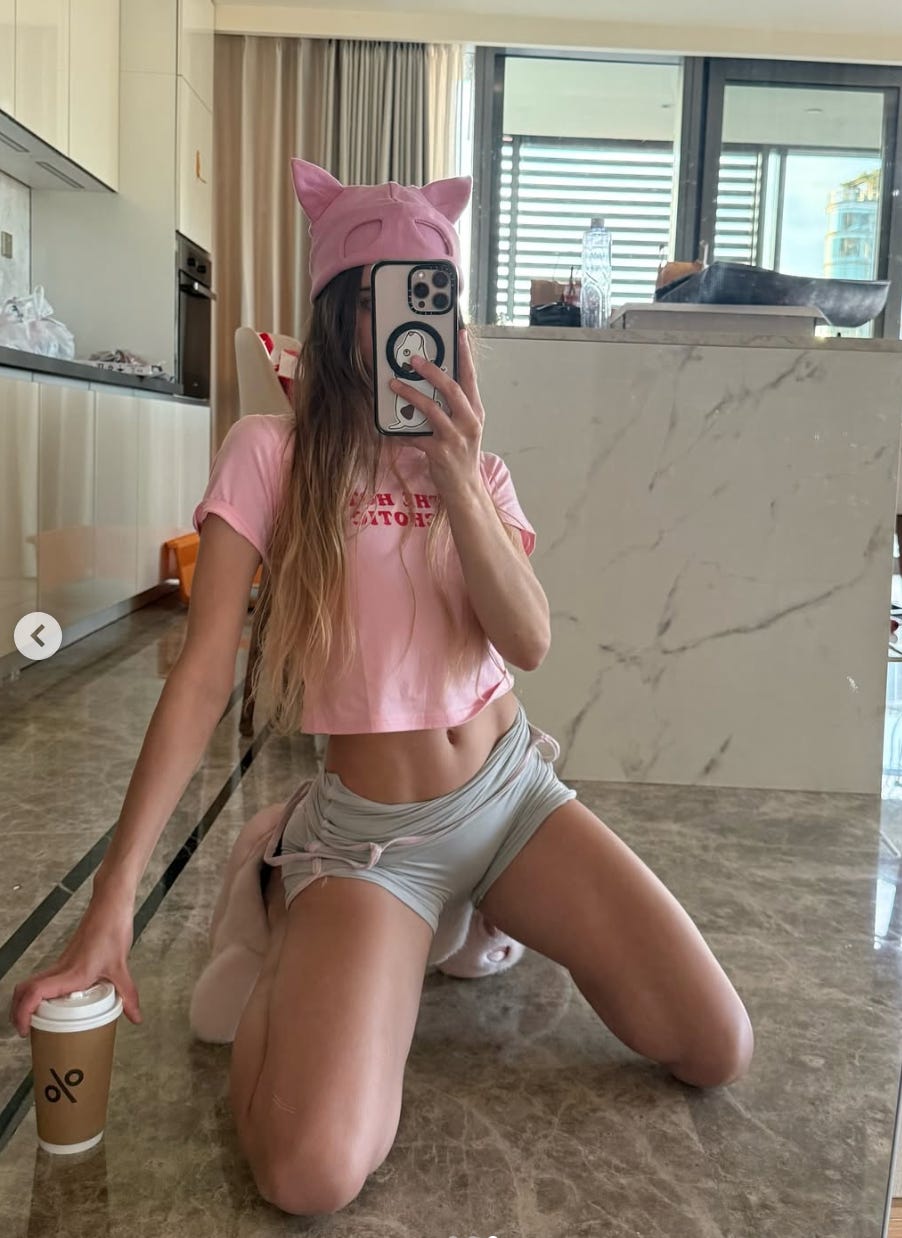
Like everyone else in NYC and perhaps globally, I have become obsessed with Angela Nikolau, the female portion of the Russian rooftopper couple who scaled the Empire State Building and got engaged.
I scrolled Nikolau’s Instagram looking to get a better sense of this person (I have not seen the couple’s Netflix doc, but I want to). In images, including those made on the Empire State Building, Nikolau often wears a little black balaclava with pointy cat ears (a nod to her catwoman climber identity). She also sometimes, as in the selfie above, wears a pink one with ears.
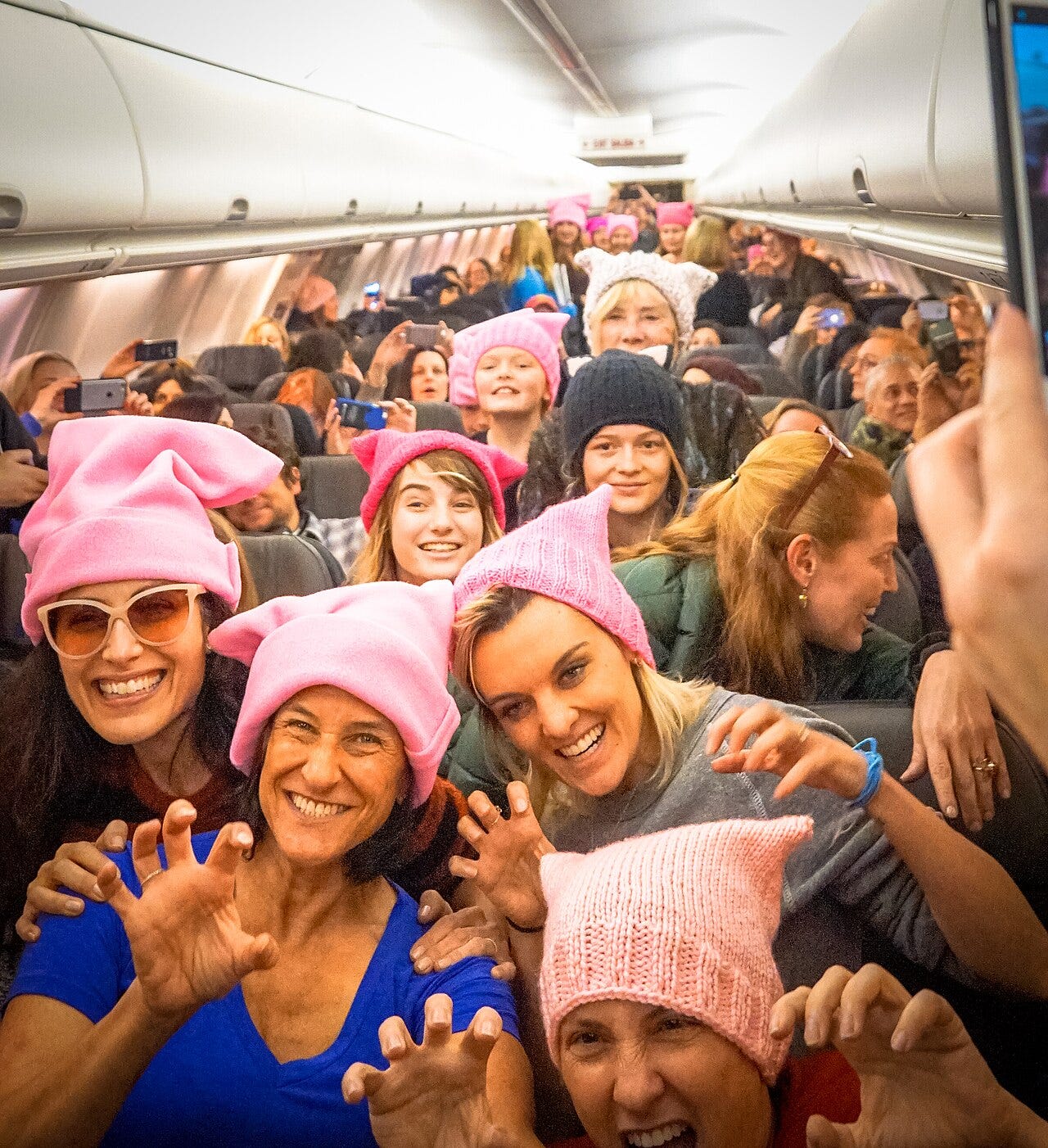
Now when have we seen a woman wearing a pink hat with ears before? Or, pardon me, when have we seen what appeared to be millions of women wearing them? 2017. The Women’s March in Washington D.C. “This pussy grabs back.” The oft-hand-knitted “pink pussy hat” was a collective aesthetic response to the release of a recording wherein President Donald Trump tells Billy Bush (regarding the sexual pliability of women once a man becomes famous): “They let you do it. You can do anything. Grab ‘em by the pussy.”
This quote always reminded me of my time working at a women’s magazine, when I was but a nerdy little editorial doormat. A beautiful editor whom I envied (and who I still like and admire to this day) was regaling us doormats with a quintessentially naughty aughties story about an encounter with her friend, the notorious Gavin McGinnes—then I believe the former editor of Vice magazine, eventually to become a Proud Boy. I don’t remember the entire story or its context, but I do remember this part: the beautiful editor was apparently joking with him about her not actually being a woman (she was in fact a woman, this was just a bit of some kind). His response was to stick his fingers in between her legs, pull them out, sniff them, and say: “Smells like cunt to me!”
This story was not told with any degree of sadness or rage or humiliation. She did not, at least at that time, view this as an assault or even really a transgression. It was more like an outrageous prank. The story was, in some way, delivered to us as a good-intentioned flex: I hang out with Gavin; I’m sexy and don’t take things seriously. Gavin wants to stick his fingers inside me. And Gavin could “get away” with it then because he was Gavin: famous and infamous in the 2000s NYC magazine world, if not the world writ large. At that time, magazine girls of a certain type absolutely loved him. And this wasn’t like “back in the bad/good old days.” This was 21st century dynamics, only about ten years prior to #metoo and pink pussy hats.
You can do anything.
I came to NYC as an inexperienced seventeen-year-old, and, despite being a nerd, I went out almost every night of the week for many years. My exposure to—and even, to a far lesser degree, my own involvement in—experiences similar to this one was formative to my worldview. These types of experiences, and my eventual willingness to view them without hard and fast judgments about what people wanted or needed or felt was OK for them, deeply affected me. I was and am also friends with a ton of gay men, whose own social and sexual codes are often infinitely creative and in many instances do not align with the mores of other communities. This inspired—and still inspires me—to think differently about what I must put in the categories of “right” and “wrong.” This is not to say that I think assault is OK—I have been assaulted more than once, at varying points in my life, and I wouldn’t wish that on anyone. It is to say that I believe grown adults, those who have agency over where and with whom they choose to hang out, have the right to their own interpretations of what is pleasurable and painful for them.
Bathed in the light of these uncomfortable and inconvenient personal truths, when women began to don the hats in 2017 I thought they looked ridiculous and I would not humiliate myself by wearing one. I expressed this view regardless of whether or not it placed me in direct opposition with the political and aesthetic proclivities of my gender. I thought that the sentiment behind the hats was incredibly hypocritical. It seemed to be more based on what the women who wore them wanted to believe about themselves as a gender—that women are immune to seeking male validation, that women always support each other, that women are the good guys and men are the bad guys, and that if only a woman were president, everything would be OK—versus the truth, which is murkier.
So what does this have to do with the aesthetics of female power and empowerment?
To put it bluntly: I think many women derive the bulk of their self worth from how much men want to sleep with them. I think many other women derive a much smaller but not insignificant portion of their self worth from this. And I think some women derive none of their self worth from this. Further, I think there are women who attach themselves socially to other women who are more overtly sexually desirable than they are, in order to claim some degree of second-order power from being in that circle. And, to complicate things even further, I think there are women who define their value, negatively or positively, by how much men don’t want to sleep with them. While these motivations are often unconscious, there is nothing truly wrong with any of them—everyone has their own values, and as a human you have to decide what your’s are and ideally make them conscious and live in as close proximity to them as possible. But wherever a woman may find herself on this scale of desiring male sexual validation, to insist that the scale doesn’t exist is a false claim.
To that end: suggesting that no woman in history has ever allowed, or more to the point wanted, a famous or otherwise high status man to “grab her by the pussy” is not accurate. I have proof otherwise. And to think that no woman has ever conferred to herself some sense of value from a man’s desire for her—even if that desire was communicated in the least gentlemanly, most pussy-grabbing way possible—is also not accurate.
Side note: I constantly observe both heterosexual men and women valiantly trying to remove the equation of desire from their lives, to act as though the gender they are attracted to doesn’t exist or has no worth. It is a fascinating thing to behold.
Trump’s individual claim related to pussy grabbing is obviously not every woman’s, or most women’s, story. So his making that kind of generalization was certainly ridiculous and evidence of someone with a distorted reality and morality. I think Trump is gross and a terrible president. I am not defending pussy grabbing, or any other kind of brutish behavior. I think a man in control of his sexual prowess understands how to wield it in a far more interesting and seductive way. But let’s be real. Some woman, somewhere, at some point in time, allowed Donald Trump to grab her by the pussy, simply because he was Donald Trump. If you do not believe that, I don’t know what to tell you. And if you think she is somehow less of a woman than you, I also don’t know what to tell you.
*****
Now back to Angela Nikolau. Thank god. Nikolau is also a wearer of pink cat-eared hats. In her images and videos, she often takes on a standardized “hot influencer girl” aesthetic of tight, athletic clothing and sexy poses. Yet, in her ability and choice to climb tall buildings with cat-like grace and agility, she represents a completely different type of female empowerment than that of the traditional pink pussy hat wearer—or the consumption-minded influencer girl.
So why is she like this? While browsing her Instagram, I came upon this story she wrote about her childhood:
I was 12. And that’s when I found out hunger can make you throw up bile.
When my parents divorced, my mom fell into a deep depression. She tried to find work — nothing came through. She started selling off watches and whatever small things we had around the house. The money ran out. None of our relatives knew how bad things had gotten — my mom didn’t want anyone to know.
At first we ate what was left in the fridge. Then whatever had been forgotten on the back of shelves. At some point all that was left was cornstarch and cloves. Mom would make kissel and throw in the cloves — for flavor. To this day I can’t drink kissel, or eat anything with cloves in it.
A week later, the starch ran out too.
The next two weeks, we ate nothing. My sister and I tried to keep ourselves busy, distracted, not thinking about it. But by the end of that second week, our bodies just gave out. We sat in the long hallway of our empty Stalin-era communal apartment — too exhausted to do anything.
We split a construction bucket and its lid between us.
We sat there and threw up bile. That was the first time I learned that was even a thing — that your body can do that, bring up bile when there’s absolutely nothing left inside. I still remember that green lid I was throwing up into. My little sister sat beside me, no strength left, holding the bucket.
It hurts to write this. My stomach literally aches as I type. But this is my story. 🤍
And if you want to know what I’m made of — there’s your answer.
I appreciated reading this. I did in fact want to know what Nikolau was made of, and why and how she does what she does. In fact, reading this brought me to tears. Could it be fake? Sure. But I don’t think someone who talks to death as often as this woman does needs to tell a fake story to impress anyone or explain herself. And the simple fact is that brilliance—including the brilliance of cultivating a mind and body capable of free climbing one of the tallest buildings in the world—doesn’t often grow from an easy childhood where all the lights automatically turned green for you. It usually grows from suffering.
This is a woman who was debased not by a man or by an impropriety, but by the circumstances of her own childhood. And she empowers herself not by huddling with the masses to declare her victim status in a silly hat, but by doing what almost everyone else can’t do (albeit in a slightly chic-er silly hat).
And in a full set:
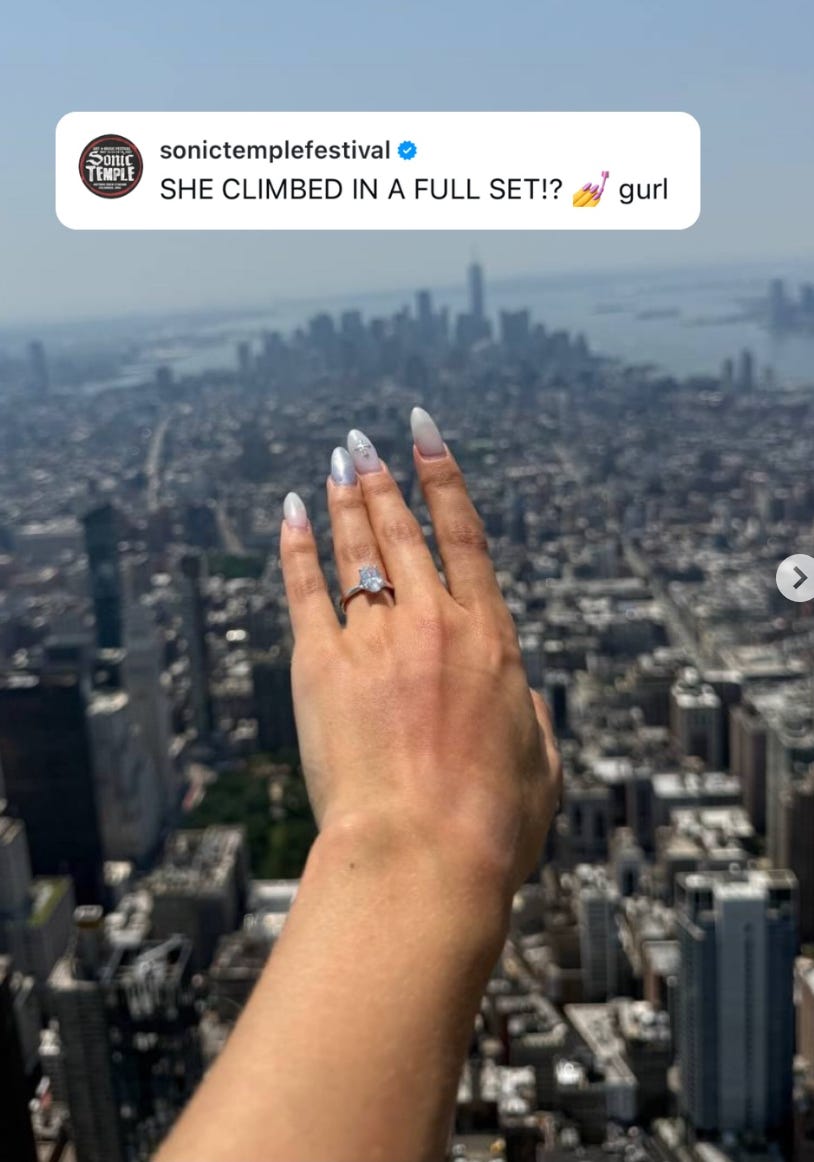
Nikolau and her mate consider themselves artists, and while I’m not super in love with their aesthetics (there is a strong whiff of shock value Russian contemporary art that just isn’t my thing—see Pyotr Pavlensky for further insight into this), I think it is obvious that these people know how to garner attention. And as w writer I do love the wink on “getting engaged at the top of the Empire State Building.”
More interesting to me is the fact that Nikolau represents some break from the way in which women have presented themselves in the past decade or so. I think this, along with the engagement stunt itself, is what is making her so interesting to people.
I myself am more interested in what the aesthetic of an Angela Nikolau-type figure means in this time period. Does her image say something different about women? That they are strong? That they can withstand pain? That they can even choose it? I felt something similar watching the Venice Biennale stunt performer Sophie Duncan (who performed as the human clapper of a bell in Florentina Holzinger’s piece SEAWORLD VENICE) and reading her take on what she does. This isn’t the only version of female empowerment, but in a rapidly dematerializing world, this emphasis on testing the limits of one’s physicality recalibrates something for me.
It also tests the boundaries of the oft-repeated “IT’S HER BODY” rejoinder, which often comes on the heels of a celeb getting mocked for too much, or too obvious, or too unclaimed, plastic surgery. It’s her body, and no one has the right to judge what she does to or with it—she gets to choose that. But while some super invasive plastic surgeries (the dreaded BBL for example) are in themselves tests to the limits of one’s physicality, there is something interesting about a woman agenticly putting her body in danger in a way that doesn’t find her comatose under the knife, aching to be more sexually desirable to men.
*****
My mother used to tell me I could be anything I wanted when I grew up. A lot of little girl’s mothers tell them this, I think. Yet, when you grow up, women often expect you to “be” just like everyone else. Sure, you can do whatever you want—but you’d better do it wearing that pink pussy hat like the rest of us. You’d better be like us. Debasement is often seen as something men do to women. Empowerment is seen as something women do for each other.
Is that true?
There is a female debasement that goes unseen in the culture of womanhood. The petty humiliations, like forcing a bridesmaid to not only wear but actually purchase a dress she hates and will never wear again—all so that she can look like all the other maids, and not outshine the bride in her virginal white. The insistence on Byzantine pecking orders and obligate conformity. The knee-jerk misandry that often underpins female friendships—in my experience, many women who date on the apps do so purely so they can have negative stories about men to laugh over with their friends. The knee-jerk misogyny that also underpins them—the Nicki Minaj friendship song from SNL is funny because it’s true. Female relationships, in both work and life, are often forged in the fire of throwing some other woman under the bus.
(This is not to say that I don’t have great female relationships. It is to say that I’ve work hard to cultivate relationships with women who have developed themselves beyond these frameworks).
So what is empowerment? What is power?
To go back to Trump: his thesis on self-empowerment seems simple. By cultivating the right qualities, you can achieve the access to anything. Cultivate fame, and fame grants you access to pussy—and you don’t even have to ask nicely, or at all. You can just reach out and grab it, like the golden ring. Cultivate wealth, and you get the spoils of Mar-A-Lago. Cultivate both, and you become the president. Is he wrong?
I am speculating here, but Nikolau’s thesis on empowerment appears more mystical, anarchic, immediate and dematerialized in orientation. Nothing gives or grants you anything. You just take it. Human life is finite, and if you want something, you don’t waste time cultivating some other thing in order to get it. You just go get it. It is, I presume, something more akin to this famous line of dialogue written by Nikolau’s fellow Russian, Ayn Rand. As she wrote in The Fountainhead:
Dean: “My dear fellow, who will let you?”
Howard Roark: “That’s not the point. The point is, who will stop me?”
So who is the more empowered here? One can’t imagine Nikolau climbing the Empire State Building on her own—it seems like the magic with her is that she’s part of a romantic coupling that allows her to do what she does. And yet I can’t help but think that if she were part of a pink-hat-wearing female friend group, she would likely never even have climbed the first rung. She would get pulled back down before she even began.
Trump can’t imagine anything coming to him without a deal or a transaction. I think he has never known anything even remotely adjacent to the feeling of risking his life for an experience that goes beyond the synthetic satisfactions of lukewarm delivery McDonald’s and the compromised pussy that’s only there for the fame or the money.
By dint of mortality, no human is ever truly or uniquely powerful. We all face death, and it takes from us in a moment that which we took a lifetime to build. Perhaps power comes from from making friends with this truth, and then climbing forever toward it.
“To put it bluntly: I think many women derive the bulk of their self worth from how much men want to sleep with them.”
This is real.
Trying to pretend otherwise is so fake.
I’m so glad I read this article.
Thank you
I love the word "murkier" an even messier version of nuance - both of which seem far too absent. Even though my hackles go up reading Ayn Rand, and long fingernails, really enjoyed reading this. And despite loving my group of female friends - I am afraid that most of them can't acknowledge the murkiness